The President Trump Nickname Comes Back Around And Cameras Catch Him With His Eyes Closed!

Donald Trump has spent years calling Joe Biden “Sleepy Joe.”
It wasn’t just another political insult.
Trump turned it into branding.
The nickname became part of a much larger argument about Biden’s age, stamina and ability to handle the presidency. Trump repeated it at rallies, during interviews and throughout multiple campaigns until you didn’t even need to hear Biden’s full name to understand exactly who Trump was talking about.
Then came an Oval Office event on September 28.
Trump brought up “Sleepy Joe” again.
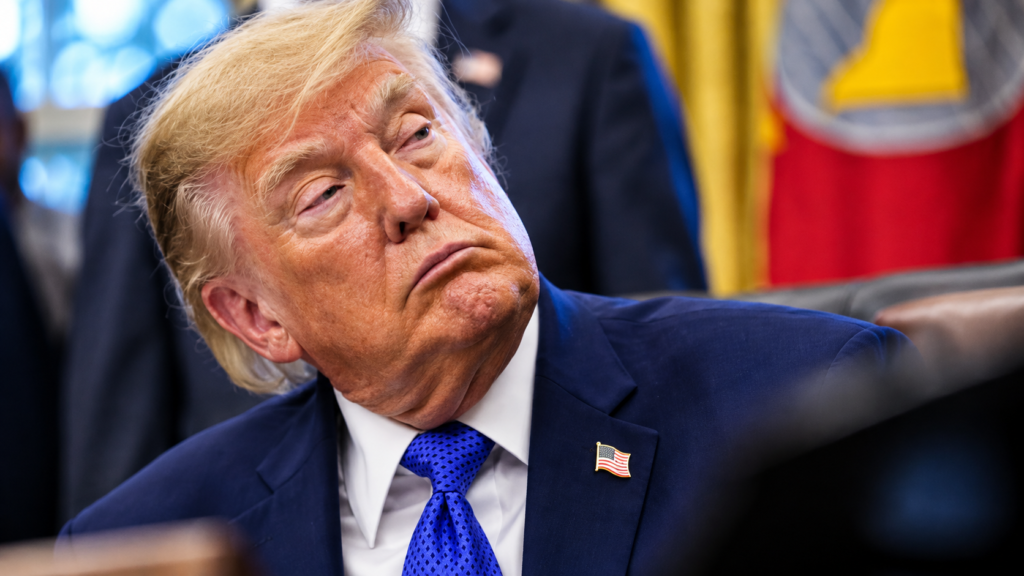
And not long afterward, cameras showed Trump sitting behind the Resolute Desk with his eyes closed and his head lowered while other people spoke.
Now, let’s be careful.
A video showing somebody with their eyes closed doesn’t give us the ability to determine exactly whether they were asleep, resting their eyes or simply tired. Reporting on the footage has appropriately described Trump as appearing to doze or struggle to remain awake rather than treating sleep as medically established fact.
But politically?
The optics are almost impossible to ignore.
The man who made “Sleepy Joe” one of the most recognizable political nicknames in America suddenly found himself becoming the subject of the exact same joke.
And that’s where this story becomes much more interesting than somebody possibly getting sleepy during a meeting.
The Nickname Was Never Really About Sleep
Let’s start there.
When Trump called Biden “Sleepy Joe,” he wasn’t literally making an argument about bedtime.
He was selling an image.
Old.
Slow.
Low energy.
Not sharp enough.
Trump has always understood something about politics that he also understood from television:
People remember characters better than policy papers.
So he gives opponents identities.
The nickname becomes shorthand for a much larger argument.
You don’t need a 20-minute discussion about whether somebody has enough stamina for the presidency.
You say:
“Sleepy Joe.”
Two words.
Everybody understands the message.
Whether people agreed with that characterization or not, the branding worked because it was simple enough to remember.
But Political Branding Creates a Trap
Here’s the problem.
Once you make somebody else’s age and energy part of your political identity, people are going to watch yours.
Every stumble.
Every verbal mistake.
Every time your eyes close.
Every time you lose your train of thought.
Every time you look tired.
That’s not necessarily fair in every individual instance.
Presidents are human beings.
Human beings get tired.
A photograph captures a fraction of a second.
A short video clip can remove context.
But once you establish the standard, don’t be surprised when people apply that same standard to you.
That’s what makes this particular moment politically awkward for Trump.
He didn’t merely appear tired during an event.
He appeared tired after invoking the nickname he created to attack somebody else for appearing tired.
And Trump Is 80 Now
There’s another reality that can’t be ignored.
Trump is now 80 years old.
That doesn’t tell us whether he can or cannot perform his job. Age alone doesn’t answer that question.
But it does mean we’re talking about an octogenarian serving in one of the most demanding positions in the world.
And that’s worth discussing because America just spent years debating whether age mattered when Joe Biden was president.
We can’t suddenly pretend the subject became irrelevant because the president changed.
If age matters for Biden, it matters for Trump.
If cognitive sharpness matters for Biden, it matters for Trump.
If stamina matters for Biden, it matters for Trump.
The standard shouldn’t depend on which politician somebody likes.
But Don’t Diagnose Somebody From a Video Clip
This is where political discussion usually goes off the rails.
Somebody sees Trump’s eyes close.
Immediately:
“He’s mentally gone.”
We don’t know that.
Somebody sees Biden forget something.
Immediately:
“Dementia.”
Again, that’s not something random people watching television are qualified to diagnose.
There’s a huge difference between saying:
“This person appeared tired.”
and saying:
“This proves this person has a neurological condition.”
The first can be an observation.
The second requires medical evidence.
Trump underwent a physical in May and publicly said that everything had checked out “perfectly”; Reuters reported the examination amid ongoing public scrutiny of his health.
People are free to question what information presidents disclose about their health.
But we shouldn’t fill gaps in information by diagnosing somebody through social-media clips.
This Isn’t the First Time People Have Raised the Question
That’s also why the latest footage gained traction.
It didn’t appear in isolation.
Trump has previously been photographed or recorded with his eyes closed during public events, leading critics to accuse him of falling asleep.
The White House has disputed some of those characterizations.
During an earlier controversy, Trump himself denied sleeping and said he had simply closed his eyes.
A Washington Post analysis of a November 2025 Oval Office event described him as apparently struggling to keep his eyes open for portions of the event, while the White House denied that he had been dozing.
He was also photographed with his eyes closed during portions of the September 11, 2026 Pentagon commemoration, which again produced online claims that he was sleeping.
None of those moments, individually, gives us a medical diagnosis.
But politically, repeated footage keeps the conversation alive.
Meanwhile, Everybody Almost Forgot What the Event Was About
And this is the crazy part about modern politics.
Trump was announcing a proposed $15 billion steel plant in Iowa.
That’s not a small announcement.
Mesabi Metallics, owned by India’s Essar Group, says the facility is intended to produce 10 million tons of steel annually once fully operational, with production targeted for 2030. The announcement also had obvious political significance because Iowa Republicans are heading into competitive midterm races.
That’s a legitimate policy and economic story.
Jobs.
Manufacturing.
Tariffs.
Foreign investment.
Domestic steel production.
Those are things people can actually debate.
But what went viral?
Trump’s eyes.
Welcome to politics in the social-media era.
The Image Usually Beats the Policy
This is something politicians still haven’t completely figured out.
You can spend an hour talking about economic policy.
Then one ten-second clip becomes the entire story.
That’s not uniquely a Trump problem.
It happened constantly to Biden.
A stumble becomes more important than the speech.
A confused expression becomes more important than the policy announcement.
A verbal mistake gets ten million views while the legislation gets fifty thousand.
Politics has become increasingly visual.
And social media doesn’t reward context.
It rewards moments.
That’s why Trump’s own political style helped create the environment now being used against him.
He understood better than almost anybody how to turn somebody else’s awkward moment into a political weapon.
Now other people are doing exactly that with him.
And That’s the Real Irony
This isn’t really a story about whether Donald Trump took a five-minute nap.
We can’t establish that from the footage alone.
It’s about what happens when political branding becomes stronger than political argument.
Trump spent years teaching voters to associate Biden with one word:
Sleepy.
Now every time Trump appears tired, that word comes bouncing back.
That’s how branding works.
You don’t get to control it forever.
Once you’ve convinced everybody that a particular characteristic is politically important, you’ve created a standard that can eventually be applied to you.
And that’s exactly what’s happening.
Reality Check
Here’s where both political sides should probably be more consistent.
Joe Biden’s age was a legitimate subject for public discussion when he was president.
Donald Trump’s age is a legitimate subject for public discussion while he’s president.
But neither man’s health should be diagnosed through memes.
There’s a difference between scrutinizing the president and pretending we’re neurologists because we watched a 12-second clip.
Ask questions.
Look at patterns.
Demand transparency.
Compare what politicians say with what they actually do.
But keep the standard consistent.
Because the most revealing part of this story isn’t whether Trump actually fell asleep.
It’s how quickly the political weapon he spent years using against somebody else was turned around and pointed directly back at him.
Trump called Biden “Sleepy Joe.”
Now cameras caught Trump with his own eyes closed.
Maybe he was asleep.
Maybe he wasn’t.
But politically?
The nickname just became a lot harder to use without somebody playing the video.
Hip Hop Rotation Question
When politicians make an opponent’s age, stamina or public mistakes part of their campaign strategy, is it fair for voters and the media to hold them to exactly the same standard when they show similar moments?